
How to Study and Revise for Your Theory Test (Whatever Your Learning Style)
There's no single "correct" way to revise for your theory test, whatever certain forums and well-meaning relatives might suggest. Some people absorb information best from a book, working through it methodically page by page.
Others need something interactive — an app that quizzes them, tracks their progress, and tells them instantly whether they got something right. Neither is superior. What matters is choosing the approach that actually works for how your brain takes in information, rather than forcing yourself through a method that leaves you frustrated and demotivated.
Let's go through what the test actually involves, then look at how to prepare for it in a way that suits you.
What You're Actually Preparing For
The UK theory test has two parts, both completed in the same sitting:
❖ Multiple choice
50 questions, drawn from an official bank of around 700, covering 14 topic areas including road signs, hazard awareness, safety margins, and rules of the road. You need 43 out of 50 correct to pass, and you're given 57 minutes to complete it — generally more time than you'll need if you've prepared properly.
❖ Hazard perception
14 video clips filmed from a driver's viewpoint, each containing at least one developing hazard (one clip contains two). You score points for spotting each hazard early, up to a maximum of 75, and need 44 to pass.
You must pass both sections in the same sitting — a strong score in one doesn't carry over if you fail the other. The test costs £23, is booked directly through gov.uk, and your pass certificate is valid for two years, so it's worth timing your theory test sensibly relative to when you expect to be ready for your practical.
Most learners with no prior driving knowledge find somewhere between 15 and 25 hours of genuine revision, spread out over a few weeks, gets them comfortably past the pass mark with room to spare. Cramming everything into the final few days tends to produce worse results and considerably more stress — a pattern I'd particularly encourage nervous learners to avoid.

If You Learn Best From Reading
If you're someone who takes information in properly by reading it, working through it in order, and returning to sections until they stick, there's no need to feel like you have to abandon that in favour of an app just because it's more common now.
❖ DVSA's official revision books
The theory test question bank, the official Highway Code, and Know Your Traffic Signs — cover everything the test could possibly draw from, in structured, topic-based form. Working through these methodically, a topic area at a time, suits anyone who prefers steady, linear progress they can visibly track with a pen and a checklist.
If this is you, it's worth pairing your reading with short recall tests as you go, rather than reading everything first and testing yourself only at the end. Reading a topic, closing the book, and trying to recall the key points from memory embeds information far more effectively than reading alone.
If You Learn Best Through Apps and Interactive Practice
If sitting down with a book leaves your mind wandering, but a quiz format with instant feedback keeps you genuinely engaged, apps are very likely your better route in.
The official DVSA Theory Test Kit app contains the complete question bank plus practice hazard perception clips, and is worth using specifically because it mirrors the real test format closely, rather than a third-party approximation of it. A number of third-party apps also offer progress tracking, letting you see exactly which topics you're weakest on and focus your remaining time there rather than repeating what you already know well.
If apps are your main method, I'd still encourage at least one full read of the Highway Code somewhere in your preparation. Apps are excellent for testing recall and pinpointing weak spots, but they can sometimes encourage memorising which answer is "correct" for a specific question, rather than genuinely understanding the underlying rule — which matters, because the real test draws from a much larger bank than any single app can fully replicate.
I've written a full, honest comparison of the current theory apps, if you'd like a more detailed look at which one might suit you specifically: Best Theory Test Apps in 2026.
If You Learn Best Through Real-World Context
Some learners take in information best neither from a page nor a screen, but through talking things through and connecting them to what they're actually experiencing on the road. If that's you, it's worth mentioning specific Highway Code topics during lessons — I'm always happy to talk through stopping distances, priority rules, or a sign you're unsure of while it's directly relevant to what we're doing, rather than leaving it purely as separate, abstract study.
Hazard perception in particular benefits from this approach. The clips test a skill you're already building every time we're out on the road together — noticing a developing situation before it becomes urgent. Talking through real hazards as we encounter them during lessons reinforces exactly the same skill the test is measuring, just in a more natural setting.
Whichever The Method, Pace Matters More Than Method
The single biggest factor in feeling calm rather than overwhelmed by theory revision isn't which resource you use — it's how you pace it. Short, regular sessions spread across several weeks beat long, irregular cramming sessions every time, both for how much actually sticks and for how anxious the whole process feels.
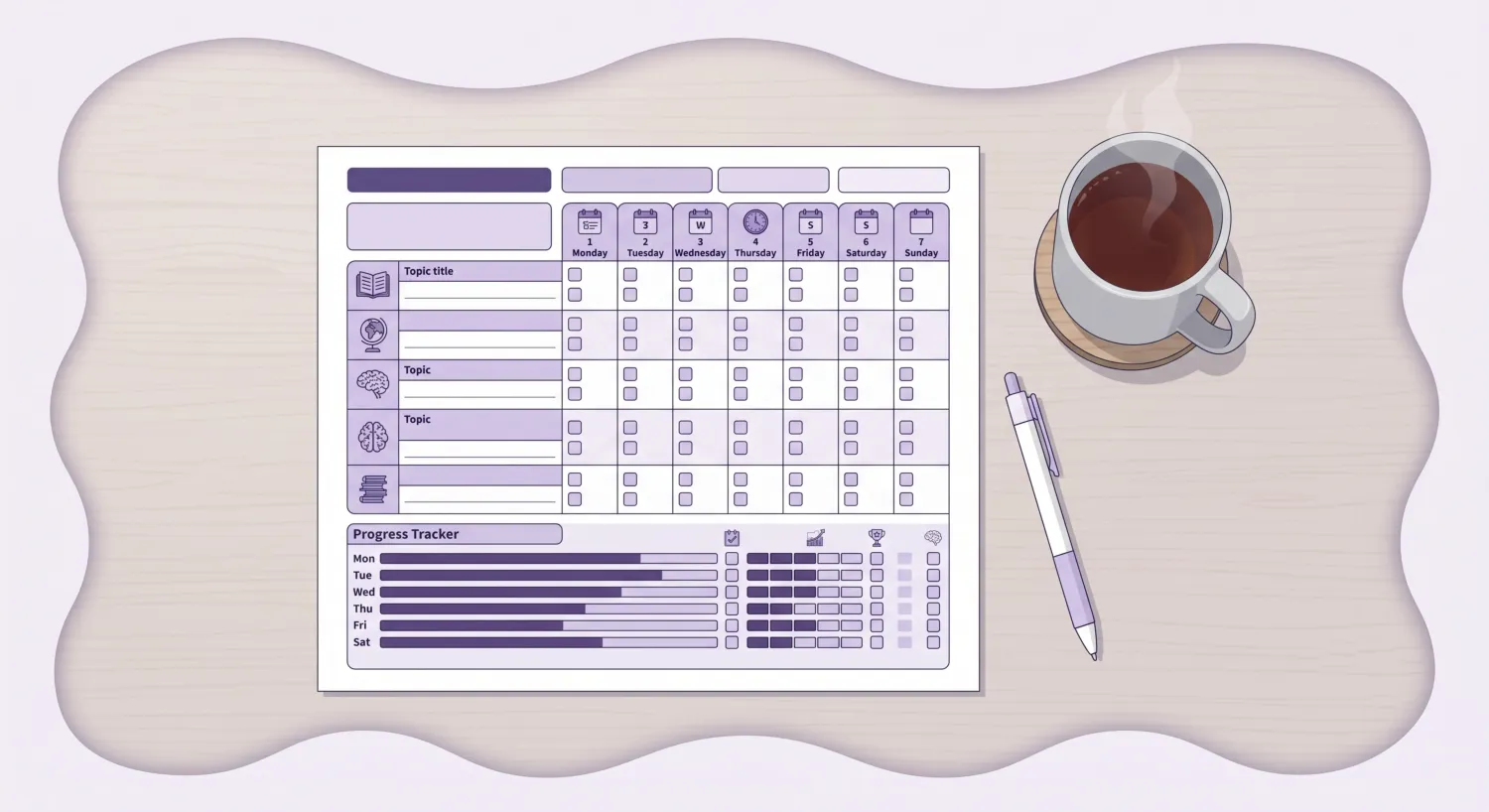
To help with this, I've put together a free printable study planner — a simple weekly layout that breaks revision into manageable sessions, includes all 14 official topic areas to track as you go, and deliberately builds in rest days rather than treating a break as falling behind. It's designed around the same pacing philosophy as everything else on this site: steady, realistic progress, not pressure.
You Don't Need to Get This Perfect
Whatever combination of book, app, or conversation ends up working for you, there's no need to follow a rigid, ideal-sounding plan exactly. If a method isn't working after a week or two, it's completely fine to switch approach rather than persist out of stubbornness. The goal is simply steady, genuine understanding by the time you sit the test — however you get there.
If you'd like to talk through how to fit theory revision around lessons, or want a copy of the study planner, feel free to get in touch. No pressure, no obligation. Just a conversation about what feels right for you.
Recent Posts
Subscribe now
If you'd like our newest guides and local road updates sent directly to you, please enter your details in the form to subscribe.
BLOG CATEGORIES
WHY CHOOSE US
Steve Paddy Driving School provides professional, patient automatic driving lessons across Chester, Ellesmere Port, and the surrounding areas. We specialise in helping nervous and anxious learners build lasting confidence by delivering a stress-free, supportive journey to real driving freedom.
Created with systeme.io | © Steve Paddy 2026 All Rights Reserved | Privacy policy | Cookie Policy | Terms & Conditions